
A Cow in Rome
Why owning a business beats owning a rock

Two thousand years ago, in ancient Rome, roughly 30 grams of gold bought you a cow.
Today, roughly 30 grams of gold buys you a cow.
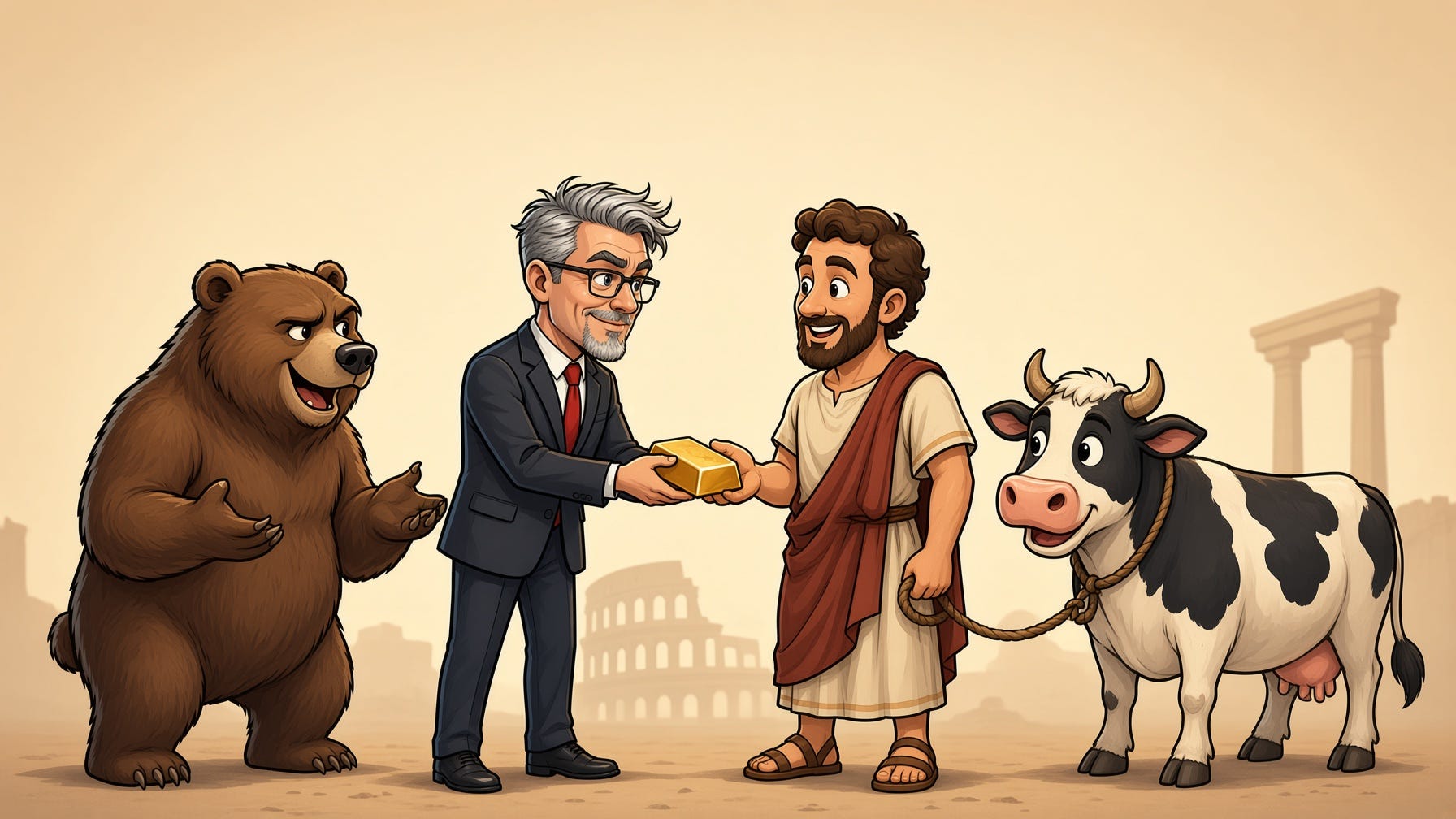
That is the whole performance review. Two millennia. Empires rose, fell, and got turned into tourist attractions. Humanity invented the printing press, the steam engine, antibiotics, and the browser tab. Gold, over that entire stretch, delivered one cow’s worth of purchasing power, start to finish.
Now, to be fair to the shiny rock: holding its value for two thousand years is not nothing. Gold has kept pace with inflation over the very long run, which is more than you can say for cash under a mattress. If the goal is “still be worth a cow in the year 4026,” gold has a genuinely strong track record.
But keeping up with inflation means zero real growth. And that is not bad luck. It is structural.
Gold is a commodity. It does not produce anything. Nobody goes to work inside a gold bar. There is no gold bar sales team hitting quota, no gold bar R&D department shipping a better gold bar next quarter, no gold bar customer paying a subscription. A bar of gold on a shelf in 1026 and a bar of gold on a shelf in 2026 have accomplished exactly the same amount: they sat there, looking expensive.
Compare that with owning a slice of a company. Behind every share, actual humans show up, most mornings, and try to make something people will pay for. They build products, fix problems, sign customers, and occasionally invent entire industries by accident. Some of the value they create flows to the owners of the business. That is the engine. When you own productive assets, other people’s Tuesdays are working for you. When you own a commodity, your entire return depends on someone later agreeing to pay more for the same inert object.
Here is the honest part, because this publication does not do convenient omissions. Gold has had spectacular decades. The last couple of them included. If you had bought at certain points, you would have crushed it, and gold owners have every right to feel smug right now. It has also had catastrophic decades: between 1980 and 2000 gold lost about 80% of its real value. Twenty years of watching a rock get quietly poorer.
Which is exactly the point. The argument here is not “gold will go down” or “gold will go up.” Nobody knows, and anyone who claims to is selling something, possibly gold. The argument is about what an asset does while you hold it. A company can create value that did not exist before. A commodity can only change hands at a new price. One is a business. The other is a very heavy opinion about the future.

Plenty of sensible people hold a small slice of commodities for diversification, and that is their call to make. This is not advice, it is a lens: when looking at anything you own, or are thinking of owning, ask one question. Does anyone go to work inside this thing?
If the answer is no, you are not investing in production. You are betting on a mood.
The cow, at least, produces milk.